

In pressure measurement systems, accuracy and safety are non-negotiable. One small component plays an outsized role in achieving both: the 2-valve manifolds. Commonly used in pressure instrumentation, this compact device enables safe isolation and controlled venting of process pressure, making it essential for maintenance, calibration, and reliable operation in industrial environments.
A 2-valve manifold is built around a simple yet effective “block and bleed” principle. One valve isolates the process pressure from the instrument, while the second valve allows trapped pressure to be safely released. This configuration protects sensitive pressure gauges, transmitters, and switches from sudden pressure changes and enables technicians to work on instruments without shutting down the entire process line.
How 2-Valve Manifolds Enable Block and Bleed for Pressure Instrumentation
In practical applications, the block valve is used to stop the flow of process media to the instrument. Once isolation is achieved, the bleed valve is opened to vent residual pressure, typically to the atmosphere or a safe discharge point. This sequence ensures that the instrument can be removed, calibrated, or replaced without risk to personnel or equipment. The simplicity of this operation is a key reason why 2-valve manifolds are widely adopted across industries.
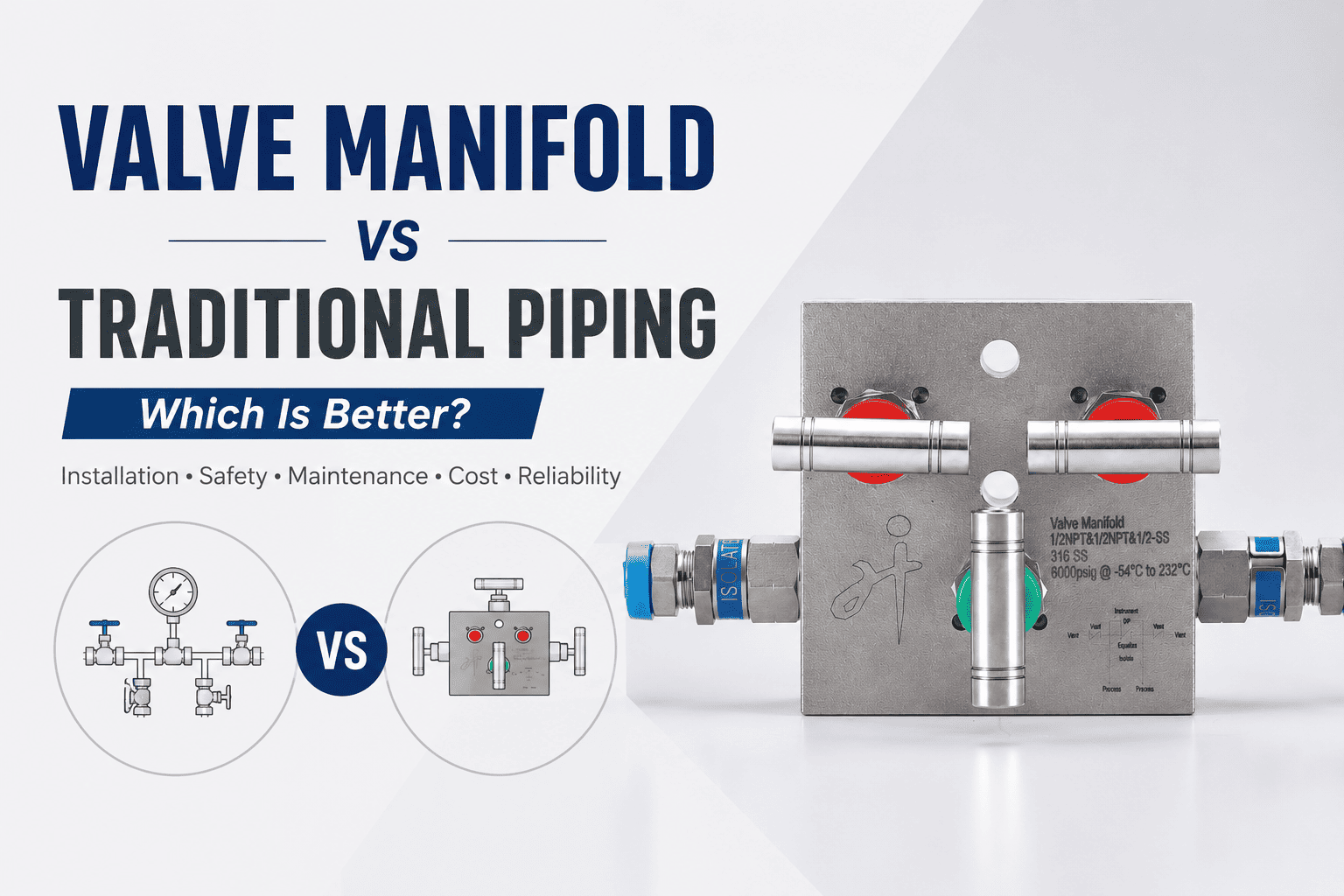
Materials and construction play a critical role in manifold performance. Most block and bleed 2-valve manifold are manufactured from stainless steel, such as SS316, to provide excellent resistance to corrosion, high pressure, and extreme temperatures. Precision-machined valve seats and stems help ensure leak-tight sealing over long service life, even in demanding environments like oil and gas, chemical processing, and power generation. Another advantage of 2 valve manifolds is their compact design. By integrating isolation and venting functions into a single assembly, they reduce the need for multiple fittings and tubing connections. This not only simplifies installation but also minimizes potential leak points, improving overall system reliability. For panel-mounted or field-installed instruments, this space-saving design is particularly valuable.
From an instrumentation standpoint, 2-valve manifolds also support accurate pressure measurement. During calibration, the manifold allows the instrument to be isolated from live process pressure while maintaining a controlled and repeatable setup. This helps ensure consistent readings and extends the lifespan of the measuring device by preventing unnecessary stress.
So 2-valve manifolds are a fundamental component in pressure instrumentation systems. Their block and bleed function provides a safe, efficient, and reliable way to isolate and vent pressure during maintenance and calibration. With robust materials, compact construction, and proven performance, they continue to be a trusted solution for industries that demand precision and safety in pressure measurement.


 English
  Arabic
  Spanish
  Russian