
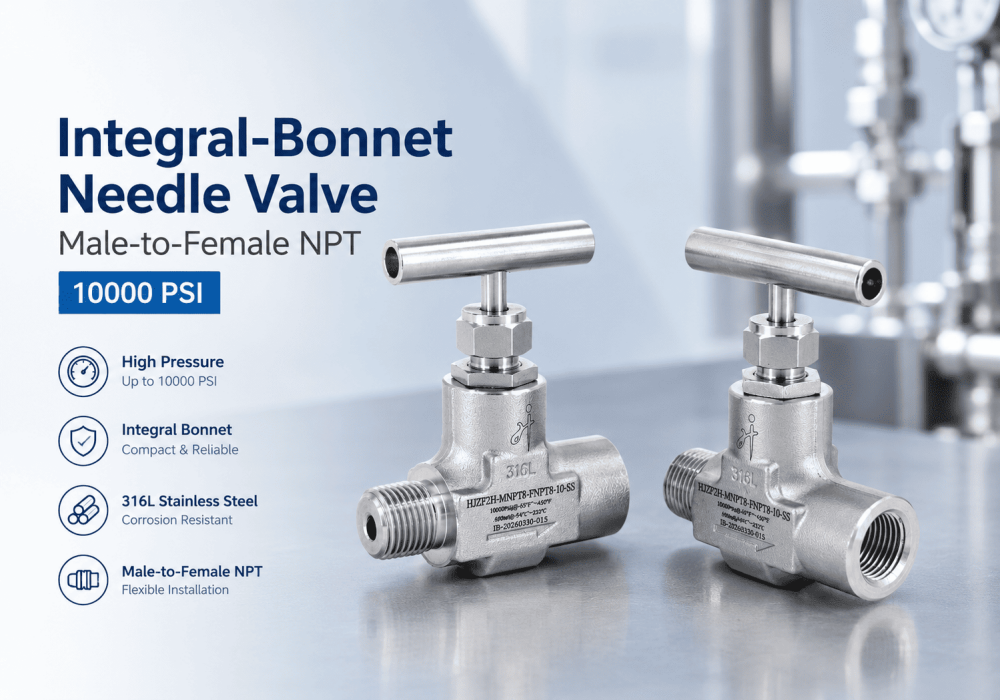
In high-pressure instrumentation systems, selecting the right valve is essential for maintaining reliable flow control, secure connections, and stable operation. An integral-bonnet needle valve with male-to-female NPT connections offers a practical solution for applications that require precise manual control and a compact threaded connection design.
Hongji manufactures industrial instrumentation valves for demanding operating environments. This article explains how a 10000 PSI integral-bonnet needle valve works, its key design features, and what engineers should consider when selecting a valve for high-pressure service.
What Is an Integral-Bonnet Needle Valve?
An integral-bonnet needle valve is a manually operated valve designed to regulate or isolate fluid flow through a small internal passage. Its needle-shaped stem moves toward or away from a precisely machined seat, changing the opening available for fluid to pass through. The integral-bonnet construction combines the bonnet and body into an integrated design rather than using a conventional separate, removable bonnet connection. Depending on the manufacturer’s specific design, this arrangement can reduce the number of pressure-containing joints and create a compact valve structure. For high-pressure instrumentation applications, the integrity of the body, stem sealing arrangement, valve seat, and threaded connections is particularly important. Each component must be designed and tested for the intended operating pressure, temperature, and process medium.
Why Choose a 10000 PSI High-Pressure Needle Valve?
A 10000 PSI needle valve is intended for high-pressure service where standard low-pressure instrumentation valves may not be suitable. A pressure rating of 10000 psi is approximately 690 bar, making pressure compatibility and installation quality critical considerations.
High-pressure needle valves are commonly used in pressure testing equipment, industrial instrumentation lines, hydraulic test systems, and other applications where controlled flow and reliable isolation are required.
The actual operating limit depends on the complete valve specification, including its material, sealing components, connection size, temperature, and applicable pressure-rating conditions. Engineers should always confirm the manufacturer’s rated operating envelope before installation.
How Does an Integral-Bonnet Design Improve Valve Construction?
The integral-bonnet design is an important feature of this type of instrumentation valve. By integrating the bonnet structure with the valve body, the design can reduce the number of separate body-to-bonnet interfaces and support a compact assembly.
This construction can be beneficial in high-pressure systems, where the number and design of pressure-containing joints deserve particular attention. A well-engineered integral-bonnet needle valve can also provide a streamlined structure for installation in instrumentation panels and compact piping assemblies.
However, integral-bonnet construction alone does not guarantee superior pressure resistance or leak-free performance. The valve’s materials, machining tolerances, stem packing, seat design, and manufacturing quality all contribute to its overall performance. For industrial buyers, it is important to evaluate the complete valve design rather than relying on the bonnet configuration alone.
Male-to-Female NPT Connections for Flexible Installation
The male-to-female NPT configuration is another important feature of this high-pressure needle valve. NPT stands for National Pipe Taper, a tapered thread system commonly used in compatible industrial piping and instrumentation connections. A male NPT connection can engage with a matching female threaded port, while the female NPT end accepts a compatible male threaded component. Combining these two connection types in one valve can simplify certain piping arrangements and may eliminate the need for a separate adapter.
This configuration can be useful when installing a needle valve between existing threaded components, pressure instruments, or compatible high-pressure tubing system interfaces. Correct thread identification is essential. NPT connections should not be assumed interchangeable with BSPT, BSPP, or other thread standards. Installation procedures and thread-sealing methods must follow the applicable connection requirements and manufacturer instructions. For high-pressure service, the complete connection assembly must be suitable for the intended pressure and process conditions.
Key Material Considerations for Stainless Steel Needle Valves
Stainless steel is widely used in instrumentation valves because of its mechanical properties and resistance to corrosion in many industrial environments. For a 316L stainless steel needle valve, the low-carbon alloy composition can offer advantages in certain corrosive service conditions.
Material selection should nevertheless be based on the actual fluid, temperature, pressure, and environmental exposure. Stainless steel is not universally resistant to every chemical, and chloride-containing environments can present particular challenges.
In addition to the valve body, engineers should consider the materials used for the stem, seat, packing, and other wetted components. Compatibility across the entire fluid-contacting assembly helps support safe and reliable operation.
If the application involves aggressive chemicals, high-purity media, hydrogen, or other specialized services, additional material compatibility and application-specific engineering review may be necessary.
Typical Applications of a 10000 PSI Integral-Bonnet Needle Valve
A high-pressure integral-bonnet needle valve can be considered for several industrial applications, provided its complete specification matches the service requirements. In oil and gas instrumentation, it may be used in compatible pressure measurement lines, sampling assemblies, and instrument isolation points. In hydraulic testing, it can provide manual control or isolation within appropriately designed high-pressure circuits.
Pressure calibration equipment and industrial test benches may also use needle valves to control fluid flow during testing procedures. In chemical processing, the valve may be suitable for instrumentation services involving compatible process media. The appropriate valve depends on the required flow capacity, operating pressure, temperature, fluid compatibility, connection standard, and expected operating frequency. A needle valve intended for fine flow adjustment should not automatically be treated as a replacement for every type of shut-off or control valve.
How to Select the Right High-Pressure Needle Valve?
Before purchasing a 10000 PSI integral-bonnet needle valve, engineers and procurement teams should verify several essential parameters.
First, confirm the maximum working pressure and the applicable pressure-temperature limits. A nominal pressure rating should not be interpreted as an unconditional rating at every temperature.
Next, verify the male and female NPT connection sizes, thread standards, and compatibility with the existing installation. Incorrect thread selection can lead to assembly problems and leakage risks.
The body and wetted-component materials should also match the process medium. For applications involving corrosive fluids or unusual temperature conditions, material compatibility must be evaluated carefully.
Finally, review the valve’s flow characteristics, sealing arrangement, pressure-testing documentation, and quality-control requirements. For critical service, request the relevant technical datasheet and confirm that the product has been tested according to the manufacturer’s specified procedures.
These checks help buyers select a valve that fits the actual application rather than choosing solely on the basis of its advertised pressure rating.
Why Consider Hongji Integral-Bonnet Needle Valves?
Hongji focuses on industrial instrumentation valves and fluid-control components for international B2B customers. When sourcing an integral-bonnet needle valve for a high-pressure application, buyers should look for clear technical specifications, consistent manufacturing quality, suitable material options, and connection configurations that match their equipment. The 10000 PSI male-to-female NPT integral-bonnet needle valve is a product option worth evaluating for systems that require high-pressure capability, manual operation, and compatible threaded connections. For project-specific requirements, confirm the exact model, connection sizes, material grade, temperature limits, and pressure-rating conditions with the manufacturer before ordering.
An integral-bonnet needle valve with male-to-female NPT connections combines manual flow control with an integrated bonnet construction and a practical threaded configuration. When properly specified for the service conditions, a 10000 PSI model can be a useful component in high-pressure instrumentation, pressure testing, and industrial fluid-control systems. For engineers and procurement professionals, the key is to evaluate the complete valve specification, including pressure-temperature limits, materials, sealing design, and connection compatibility.


 English
 Arabic
 Spanish
 Russian