
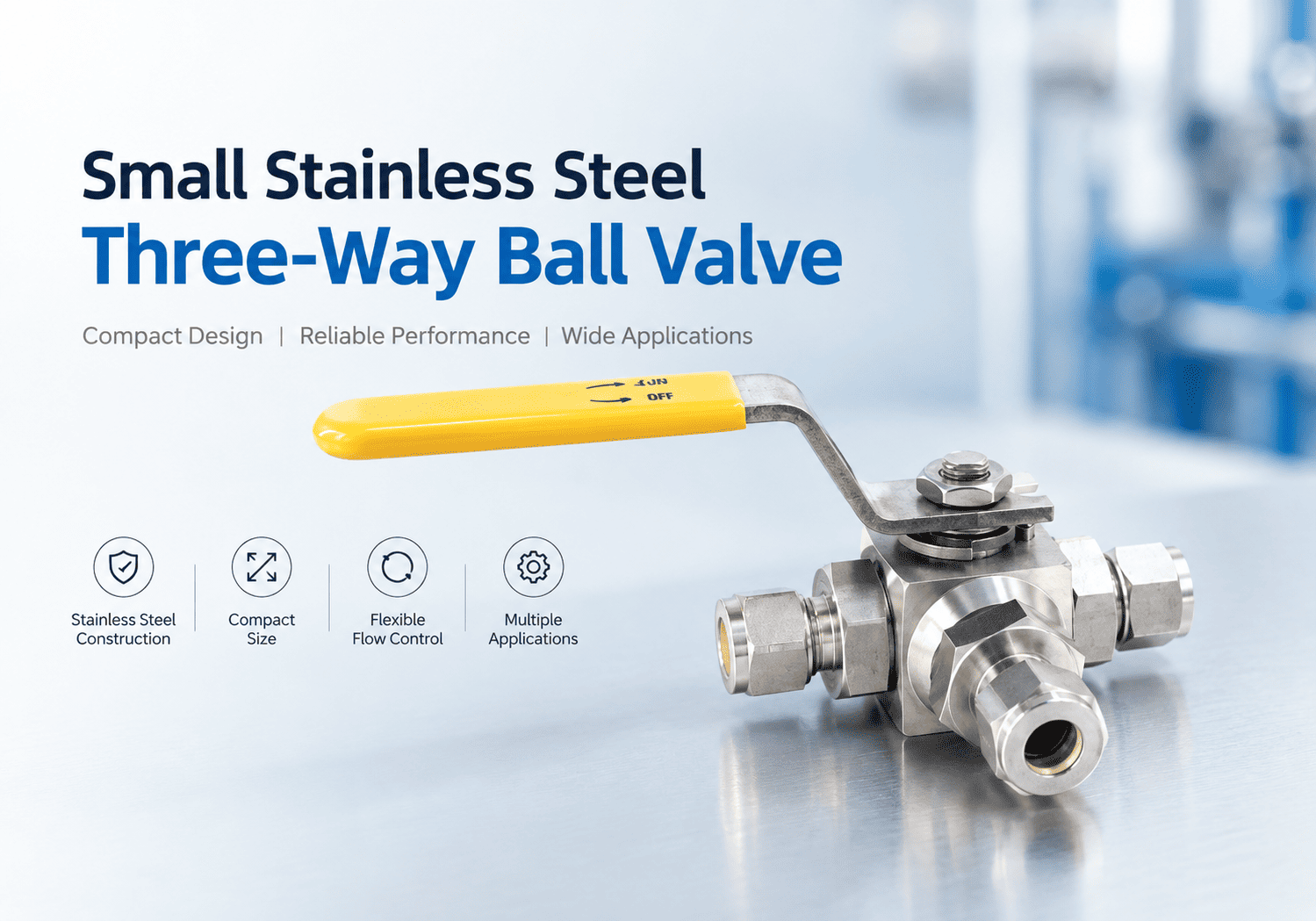
In small-bore fluid systems, valve size does not necessarily determine its importance. A compact valve may control, divert, isolate, or select the flow path of an entire instrumentation system. The small stainless steel three-way ball valve is one example of a compact component designed to provide practical flow-direction control while occupying minimal installation space. Unlike a conventional two-way ball valve, a three-way ball valve has three ports connected through a specially machined ball. By rotating the handle, the operator can change the internal flow path and connect different ports according to the required system configuration. For instrumentation, hydraulic, pneumatic, sampling, and process applications, this design can provide multiple flow-control functions in a single compact valve.
Three-way ball valves are commonly used in instrumentation systems where several small-bore lines need to be controlled within a limited installation area. Manufacturers of instrumentation valves commonly offer three-way designs for diverting or selecting process media. The valve shown in the product image has a compact metal body, three connection ports, and a manual lever handle. This configuration makes it particularly suitable for applications where quick manual operation and space efficiency are important.
Why Use Stainless Steel for a Three-Way Ball Valve?
Material selection is an important consideration when specifying a valve for industrial service. Stainless steel is widely used for instrumentation valves because it provides a combination of mechanical strength and corrosion resistance. 316 stainless steel is especially common in instrumentation and process applications. A stainless steel three-way ball valve can therefore be considered when the system requires a compact valve body with resistance to many industrial environments. Depending on the actual valve specification, stainless steel three-way ball valves may be used with compatible liquids and gases in applications including instrumentation, hydraulic systems, pneumatic systems, chemical processing, oil and gas equipment, and analytical systems. However, material selection should always be based on the actual medium, pressure, temperature, concentration, and environmental conditions rather than simply selecting stainless steel as a general-purpose material.
How Does a Three-Way Ball Valve Work?
The operating principle is relatively simple. The handle is connected to the valve stem, which rotates the internal ball. The ball contains a passage that determines which ports communicate with one another. A quarter-turn operation can change the flow configuration quickly. Depending on whether the valve uses an L-port or T-port ball design, the available flow paths can be different.
An L-port configuration is generally used when the purpose is to switch flow between different lines. A T-port configuration can provide additional flow-routing possibilities, depending on the valve design and port arrangement.
This is one reason why engineers should not select a three-way ball valve based only on the number of ports. The internal flow pattern is equally important. Before ordering a valve, the required flow path should be clearly defined.
How to Select the Right Stainless Steel Three-Way Ball Valve
Choosing a three-way ball valve involves more than selecting the correct connection size. The first consideration is the flow configuration. Determine whether the system requires an L-port, T-port, or another specific internal flow pattern. The second consideration is connection type. Depending on the design, three-way instrumentation ball valves can be supplied with threaded connections or tube-fitting connections. Some instrumentation designs are available with compression or double-ferrule tube ends. The third consideration is pressure rating. A compact valve should never be assumed to be a high-pressure valve simply because it has a stainless steel body. The manufacturer’s pressure rating must match or exceed the actual operating requirements.
The fourth consideration is temperature. Valve seats and seals can have temperature limitations that are different from the metallic body. Therefore, the complete valve assembly should be evaluated for the intended temperature range.
Finally, consider the fluid compatibility. The body, ball, stem, seats, seals, and connection materials should all be compatible with the process medium. A small stainless steel three-way ball valve is more than a miniature version of a standard ball valve. Its three-port architecture allows one compact component to perform flow switching, selection, diversion, or distribution functions in small-bore fluid systems. For instrumentation and industrial applications where installation space is limited, a compact three-way design can simplify the fluid-control arrangement while providing convenient manual operation. The key to selecting the correct valve is understanding the complete application: flow pattern, connection type, pressure, temperature, medium, material, and required flow path.
When these parameters are correctly matched, a small stainless steel three-way ball valve can become a practical component for instrumentation, hydraulic, pneumatic, sampling, and process-control systems.


 English
 Arabic
 Spanish
 Russian