
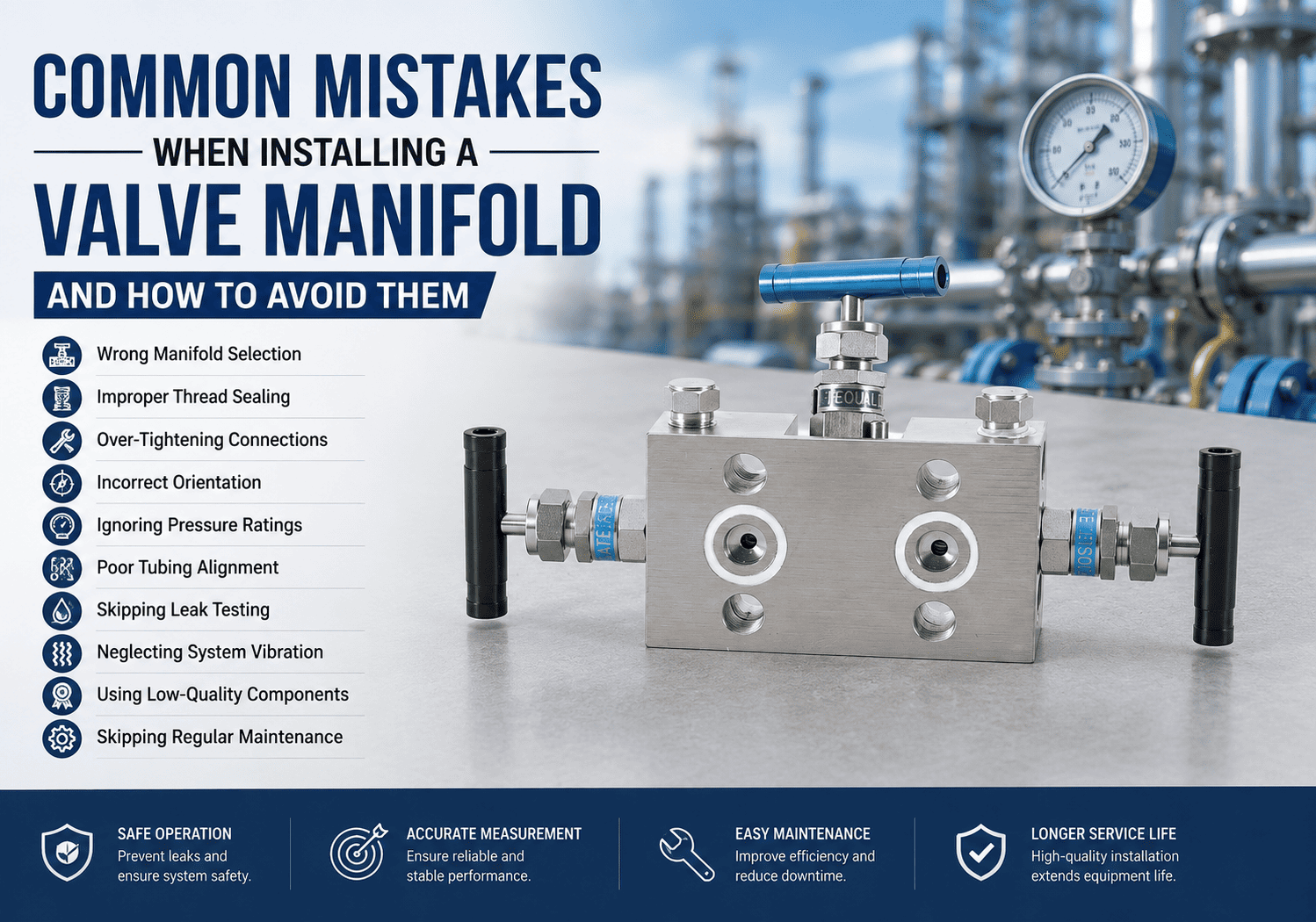
Acero inoxidable valve manifolds play a critical role in pressure measurement and instrumentation systems. Whether used with pressure gauges, transmitters, or differential pressure instruments, a properly installed valve manifold helps ensure accurate readings, safe operation, and reliable system performance.
However, even high-quality valve manifolds can experience problems if they are installed incorrectly. Installation mistakes may lead to leakage, inaccurate measurements, equipment damage, unplanned downtime, and increased maintenance costs.
In this guide, we examine the most common valve manifold installation mistakes and explain how to avoid them.
Why Proper Valve Manifold Installation Matters
A valve manifold is more than just a connection point between the process line and the instrument. It allows operators to isolate, equalize, vent, and calibrate instrumentation safely.
Improper installation can affect:
- Pressure measurement accuracy
- Instrument lifespan
- Process safety
- Maintenance efficiency
- Overall system reliability
For critical industrial applications, following correct installation procedures is essential.
Mistake #1: Choosing the Wrong Valve Manifold Configuration
One of the most common errors occurs before installation even begins—selecting the wrong manifold type.
Different applications require different configurations:
2-Valve Manifold
Typically used for pressure gauges and pressure transmitters.
Commonly used with differential pressure transmitters.
5-Valve Manifold
Designed for advanced differential pressure measurement systems where venting and calibration functions are required.
Using an incorrect manifold configuration can limit functionality and complicate maintenance procedures.
Best Practice
Always verify the instrument type and application requirements before selecting a manifold.
Mistake #2: Improper Thread Sealing
Threaded connections are often a source of leakage when installed incorrectly.
Common mistakes include:
- Applying excessive thread sealant
- Using incompatible sealing materials
- Damaged threads
- Mixing thread standards such as NPT and BSPT
These issues can prevent proper sealing and create leak paths.
Best Practice
Inspect all threads before assembly and use the correct sealing method recommended for the connection type.
Mistake #3: Over-Tightening Connections
Many installers assume tighter is better.
In reality, excessive tightening can damage:
- Threads
- Valve seats
- Instrument connections
- Tube fittings
Over-tightening may also make future maintenance difficult.
Best Practice
Follow manufacturer torque recommendations and use appropriate installation tools.
Proper torque provides a secure seal without damaging components.
Mistake #4: Incorrect Manifold Orientation
Valve manifolds are designed to provide easy access to isolation, equalization, and vent valves.
Incorrect positioning can create several problems:
- Difficult operation
- Restricted maintenance access
- Increased installation stress
- Reduced safety during calibration procedures
- Best Practice
Install the manifold in an accessible position that allows operators to safely operate all valves and perform routine maintenance.
Mistake #5: Ignoring Pressure Ratings
Not all valve manifolds are designed for the same operating pressures.
Installing a manifold below the required pressure rating may result in:
- Leakage
- Component deformation
- Premature failure
- Safety risks
- Best Practice
Always confirm that the manifold pressure rating exceeds the maximum operating pressure of the system. High-pressure applications should use manifolds specifically designed for instrumentation service.
Mistake #6: Poor Tubing Alignment
Misaligned tubing places unnecessary stress on fittings and manifold connections.
Over time, this stress can cause:
- Leaks
- Thread damage
- Vibration-related failures
- Best Practice
Ensure tubing is properly supported and aligned before tightening connections. A stress-free installation improves long-term reliability.
Mistake #7: Failing to Perform Leak Testing
Some installations are placed into service immediately after assembly without proper testing.
This can allow small leaks to go unnoticed until they become major issues.
Best Practice
Conduct leak testing before commissioning the system.
Common testing methods include:
- Pressure testing
- Hydrostatic testing
- Pneumatic leak testing
- Soap solution inspection
Verifying connection integrity before operation reduces risk significantly.
Mistake #8: Neglecting System Vibration
Industrial environments often expose instrumentation systems to vibration from pumps, compressors, and rotating equipment. Continuous vibration can loosen connections and reduce sealing effectiveness.
Best Practice
Use proper tubing supports, mounting brackets, and high-quality instrumentation fittings to minimize vibration effects.
Regular inspections are also recommended in high-vibration applications.
Mistake #9: Using Low-Quality Components
A valve manifold system is only as reliable as its weakest component.
Low-quality valves, fittings, or tubing can lead to:
- Corrosion
- Leakage
- Measurement errors
- Short service life
- Best Practice
Choose high-quality colectores de válvulas de acero inoxidable and instrumentation fittings manufactured to recognized industry standards.
The initial investment often results in lower maintenance costs and longer service life.
Mistake #10: Skipping Regular Maintenance
Even a perfectly installed valve manifold requires periodic inspection. Over time, process conditions may affect system performance.
Potential issues include:
- Corrosion
- Seal wear
- Vibration loosening
- Mechanical damage
- Best Practice
Implement a preventive maintenance schedule that includes visual inspections, leak checks, and operational testing.
Routine maintenance helps identify problems before they cause downtime.
Proper valve manifold installation is essential for safe and accurate instrumentation performance. Many common problems—including leakage, inaccurate readings, and premature component failure—can be traced back to installation mistakes.
By selecting the correct manifold configuration, following proper installation procedures, using quality components, and conducting regular maintenance, operators can maximize system reliability and extend equipment service life.
Whether installing a 2-valve manifold, 3-valve manifold, or 5-valve manifold, attention to detail during installation can significantly improve long-term performance and safety.


 Spanish
  English
  Arabic
  Russian