
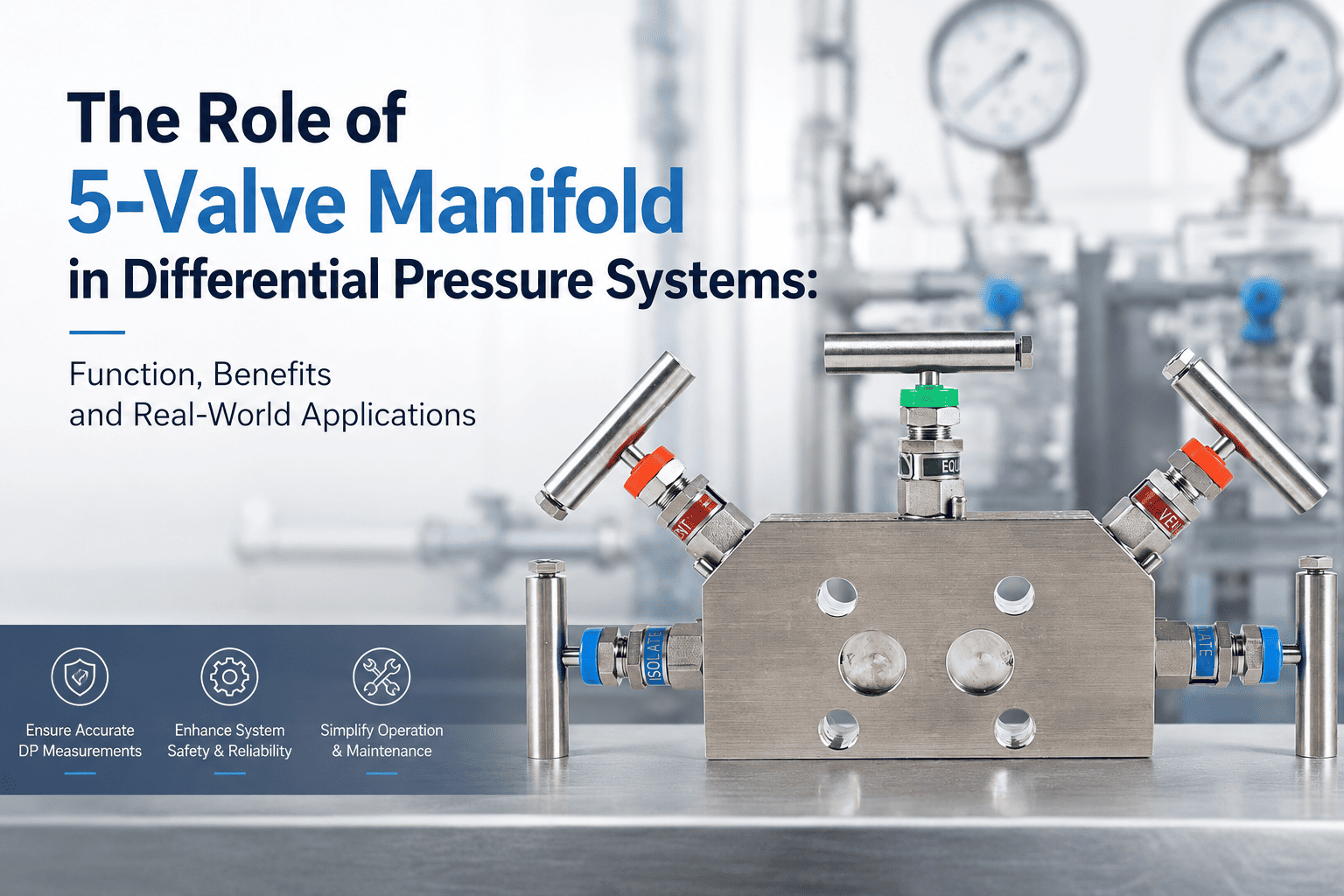
In modern industrial process control systems, pressure measurement accuracy directly affects safety, efficiency, and production stability. Industries such as oil & gas, petrochemical processing, power generation, offshore engineering, and chemical manufacturing all rely heavily on differential pressure transmitters for monitoring flow, liquid level, and pressure. To ensure these instruments operate safely and accurately, engineers commonly use a 5-valve manifold as part of the instrumentation assembly.
Although compact in appearance, a 5-valve manifold plays a critical role in isolating, balancing, venting, and calibrating differential pressure transmitters. Choosing the correct manifold configuration can improve maintenance efficiency, reduce leakage risks, and extend instrument life.
This article explains what a 5-valve manifold is, how it works, where it is used, and why it remains one of the most important components in industrial instrumentation systems.
What Is a 5-Valve Manifold?
A 5-valve manifold is an integrated valve assembly designed for differential pressure measurement systems. It combines five individual valves into one compact body.
These valves typically include:
- 2 isolation valves
- 1 equalizing valve
- 2 vent or drain valves
The manifold is mounted between the process line and the differential pressure transmitter.
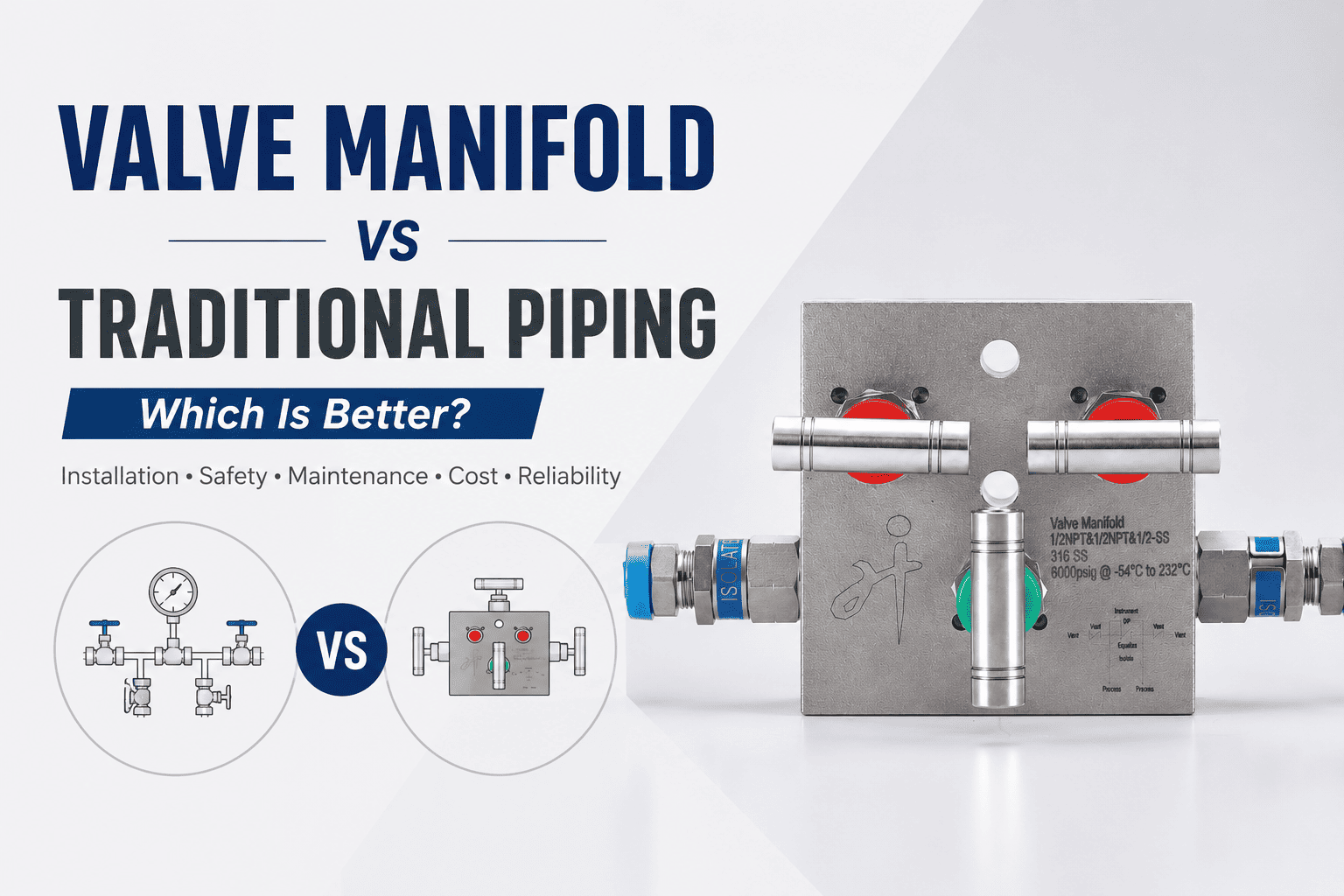
Its primary function is to allow safe instrument isolation, pressure equalization, calibration, maintenance, and venting without shutting down the entire process system. Compared with traditional multiple-valve piping arrangements, an integrated 5-valve manifold reduces installation complexity, minimizes leakage points, and improves operational safety.
Main Components of a 5-Valve Manifold
- Isolation Valves
The two isolation valves connect the high-pressure side and low-pressure side of the process to the transmitter.
These valves allow operators to:
- Shut off process pressure during maintenance
- Protect instruments from pressure surges
- Remove transmitters safely
- Prevent contamination during calibration
High-quality isolation valves are designed with precision needle stems to provide reliable sealing under high-pressure conditions.
- Equalizing Valve
The equalizing valve connects the high-pressure and low-pressure sides internally.
When opened, pressure becomes balanced across the transmitter.
This function is extremely important during startup and shutdown procedures because sudden differential pressure spikes can damage sensitive transmitter diaphragms.
Proper equalization also improves calibration accuracy.
- Vent or Drain Valves
The two vent/drain valves are used to:
- Release trapped pressure
- Drain process fluid
- Remove air or gas pockets
- Assist in transmitter calibration
- Improve maintenance safety
Depending on the application, these ports may also be connected to bleed systems or test equipment.
How Does a 5-Valve Manifold Work?
The operation of a 5-valve manifold follows a controlled sequence.
Funcionamiento normal
During standard operation:
- Both isolation valves remain open
- The equalizing valve remains closed
- Vent valves remain closed
This allows the differential pressure transmitter to measure the process normally.
Calibration or Maintenance Procedure
When maintenance or calibration is required:
Step 1: Open the Equalizing Valve
Opening the equalizing valve balances pressure between the high and low sides.
Step 2: Close Isolation Valves
Both isolation valves are closed to isolate the transmitter from process pressure.
Step 3: Open Vent Valves
Residual pressure is safely released through the vent or drain valves.
Step 4: Perform Calibration or Service
Technicians can now safely remove or calibrate the transmitter.
This sequence helps prevent instrument damage and improves operator safety.
Why Are 5-Valve Manifolds Important?
Improved Safety
Industrial systems often operate under extremely high pressure and temperature conditions.
A properly designed 5-valve manifold allows safe isolation and depressurization before maintenance work begins.
This reduces the risk of:
- Sudden pressure release
- Instrument failure
- Hazardous fluid exposure
- Process accidents
Better Measurement Accuracy
Pressure equalization helps protect transmitter sensing elements from overpressure damage.
Stable pressure conditions improve long-term measurement consistency and reduce calibration drift.
Reduced Leakage Points
Integrated manifolds replace multiple fittings and pipe connections.
Fewer connections mean:
- Lower leakage risk
- Easier installation
- Reduced maintenance costs
- Improved system reliability
Faster Maintenance
Technicians can isolate and service transmitters quickly without affecting the entire process line.
This helps minimize downtime in critical industrial operations.
Common Applications of 5-Valve Manifolds
Industria del petróleo y el gas
5-valve manifolds are widely used in:
- Offshore platforms
- Refineries
- Gas processing systems
- Pipeline monitoring
These environments often involve high-pressure and corrosive media, requiring durable stainless steel manifold designs.
Procesamiento químico
Chemical plants require precise pressure monitoring for process stability and safety.
5-valve manifolds help maintain accurate transmitter performance while enabling safe maintenance procedures.
Power Plants
Power generation systems use differential pressure transmitters to monitor:
- Steam flow
- Boiler pressure
- Cooling systems
- Turbine performance
Reliable manifold assemblies are essential for maintaining operational stability.
Water Treatment Systems
In water and wastewater applications, manifolds help operators monitor filtration pressure, pump performance, and liquid levels.
Materials Used in 5-Valve Manifolds
Material selection depends on pressure rating, operating temperature, and media compatibility.
Common materials include:
Stainless Steel 316 / 316L
This is the most widely used material due to:
- Excellent corrosion resistance
- High strength
- Long service life
- Compatibility with many industrial fluids
- Alloy Materials
For highly corrosive or extreme-temperature environments, manufacturers may use:
- Monel
- Hastelloy
- Duplex stainless steel
- Inconel
These materials provide superior resistance in demanding applications.
Connection Types Available
Different process systems require different connection standards.
Common manifold connection options include:
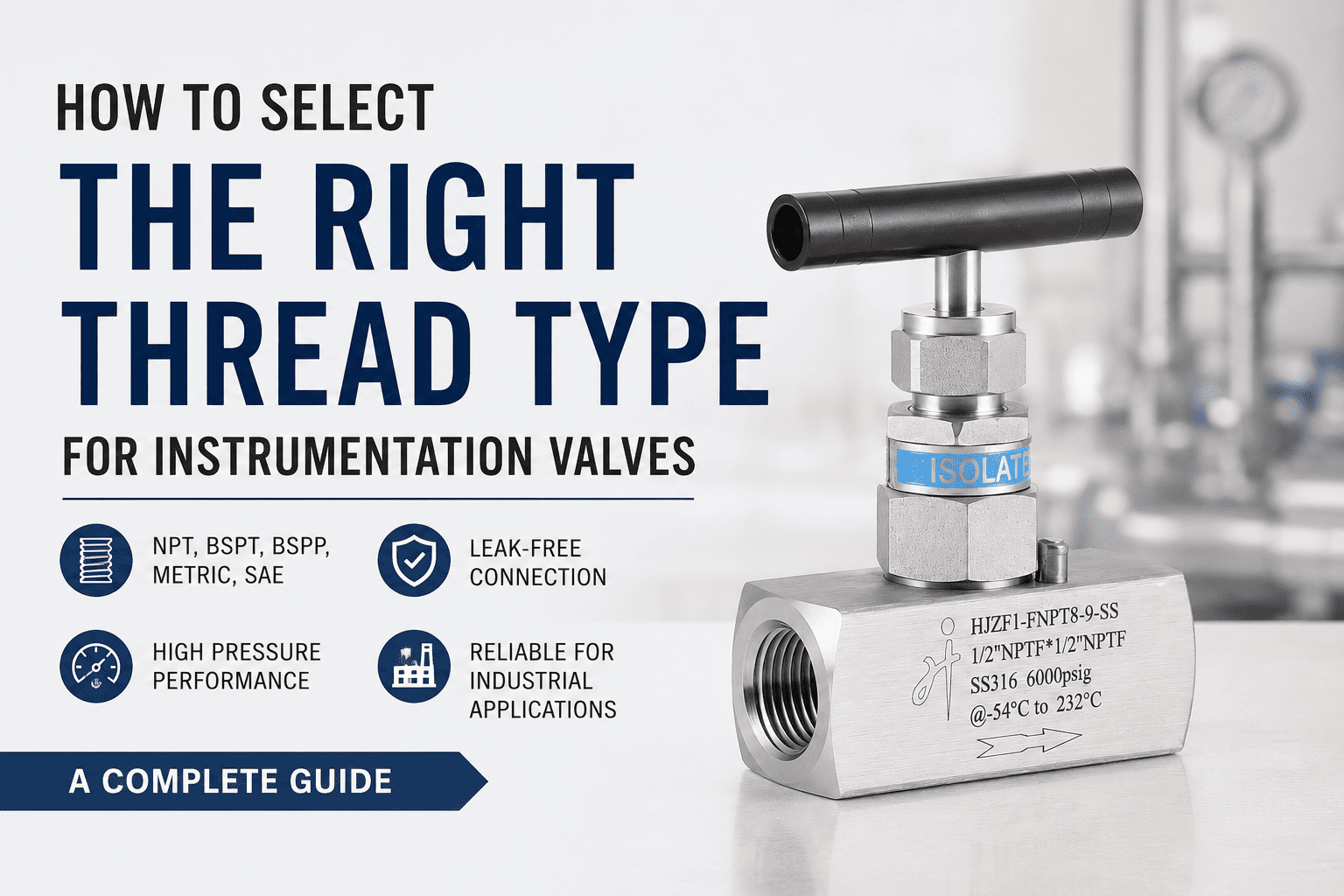
- NPT female threads
- BSP threads
- Flanged connections
- Tube fittings
- Custom process interfaces
Selecting the correct connection type helps ensure leak-free installation and compatibility with existing systems.
How to Choose the Right 5-Valve Manifold
Choosing the correct manifold requires evaluating several factors.
Clasificación de presión
Ensure the manifold pressure rating exceeds the maximum system operating pressure.
High-pressure applications may require specially designed needle valves and reinforced body structures.
Process Media Compatibility
Always verify material compatibility with the process fluid or gas.
Corrosive media may require upgraded alloy materials.
Rango de temperatura
Extreme temperatures affect sealing performance and material strength.
Choose valve materials suitable for the operating environment.
Mounting Style
Direct mount and remote mount configurations are available depending on transmitter installation requirements.
Industry Standards
Reliable manufacturers design manifolds according to international standards to ensure safety and performance consistency.
Advantages of Integrated Valve Manifold Designs
Modern integrated valve manifold designs offer several advantages over traditional tubing assemblies.
Compact Structure
Integrated bodies save installation space and simplify piping layouts.
Lower Installation Cost
Fewer fittings and connections reduce labor requirements.
Enhanced Reliability
Integrated machining improves sealing performance and structural strength.
Easier Operation
Clearly labeled valve positions improve operator efficiency during maintenance and calibration.
Maintenance Tips for 5-Valve Manifolds
Regular maintenance helps maximize service life and system safety.
Recommended practices include:
- Inspecting for external leakage
- Verifying valve operation periodically
- Checking thread and sealing condition
- Cleaning vent ports
- Replacing damaged seals promptly
- Performing routine pressure testing
Preventive maintenance can significantly reduce unexpected downtime.
Future Trends in Industrial Valve Manifolds
As industrial automation continues to advance, valve manifold systems are evolving toward:
- Higher pressure capability
- Improved corrosion resistance
- Compact lightweight designs
- Better compatibility with smart instrumentation
- Enhanced sealing technologies
Manufacturers are also focusing on precision machining and stricter quality control to meet increasingly demanding industrial requirements.
A 5-valve manifold is a critical component in differential pressure measurement systems. By combining isolation, equalization, and venting functions into one compact assembly, it improves safety, maintenance efficiency, and measurement reliability. From oil & gas facilities to chemical plants and power stations, these manifolds play a key role in protecting transmitters and ensuring accurate process control.
When selecting a 5-valve manifold, factors such as pressure rating, material compatibility, connection type, and operating environment should always be carefully evaluated. High-quality manifold assemblies not only improve system performance but also help reduce long-term maintenance costs and operational risks. For industrial applications that demand reliable pressure instrumentation, a properly engineered 5-valve manifold remains one of the most effective solutions available today.


 Spanish
  English
  Arabic
  Russian