
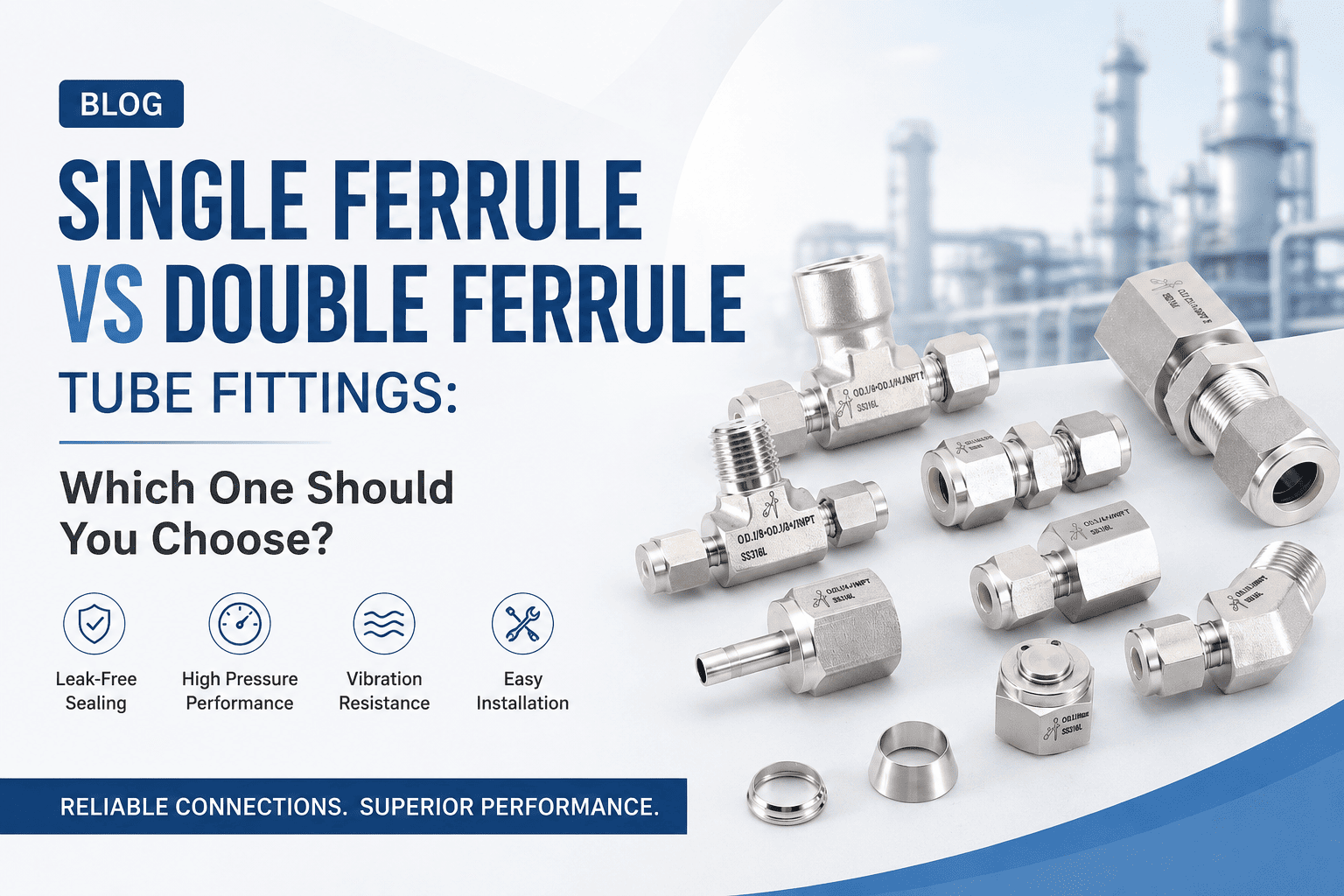
In industrial fluid systems, tube fittings play a critical role in ensuring leak-free and reliable connections. Among the many fitting designs available today, single ferrule and double ferrule tube fittings are two of the most commonly used options in instrumentation, oil & gas, chemical processing, and high-pressure applications.
But which one is better for your system?
Choosing the right ferrule fitting directly affects sealing performance, vibration resistance, installation reliability, and long-term maintenance costs. In this guide, we’ll explain the key differences between single ferrule and double ferrule tube fittings, their advantages, limitations, and how to select the right option for your application.
What Are Ferrule Tube Fittings?
Ferrule tube fittings are mechanical compression fittings used to connect tubing in fluid and gas systems. They create a tight seal by compressing one or more ferrules around the tube when the fitting nut is tightened.
These fittings are widely used because they provide:
- Leak-free sealing
- Easy installation
- High pressure capability
- Strong vibration resistance
- Reusability in many applications
Ferrule fittings are commonly manufactured from stainless steel, brass, carbon steel, and alloy materials depending on operating conditions.
Typical applications include:
- Instrumentation systems
- Hydraulic systems
- Chemical processing plants
- Semiconductor industries
- Oil & gas pipelines
- Laboratory equipment
What Is a Single Ferrule Tube Fitting?
A single ferrule fitting uses one ferrule to perform both gripping and sealing functions simultaneously. When the nut is tightened, the ferrule compresses directly onto the tubing, creating a seal while also holding the tube in place.
Main Characteristics of Single Ferrule Fittings
- Simpler internal structure
- Fewer components
- Faster installation
- Lower manufacturing cost
- Suitable for medium-pressure systems
Single ferrule designs are commonly used in general industrial applications where vibration and extreme pressure are not major concerns.
Advantages of Single Ferrule Fittings
- Cost-Effective
Single ferrule fittings are generally more affordable due to their simpler design and reduced component count.
- سهولة التركيب
The installation process is straightforward and requires less assembly time.
- Compact Design
Their smaller structure makes them suitable for installations with limited space.
- Lower Maintenance Requirements
Fewer components often mean easier inspection and maintenance.
What Is a Double Ferrule Tube Fitting?
A double ferrule fitting uses two separate ferrules:
- Front ferrule for sealing
- Back ferrule for gripping and tube holding
This dual-ferrule design separates the sealing and gripping functions, resulting in improved performance under demanding conditions.
Double ferrule fittings are widely used in high-pressure and high-vibration environments where connection integrity is critical.
Main Characteristics of Double Ferrule Fittings
- Dual-ferrule construction
- Enhanced vibration resistance
- Superior sealing performance
- Better tube protection
- High pressure capability
Advantages of Double Ferrule Tube Fittings
- Excellent Leak Prevention
The front ferrule creates a strong seal while the back ferrule securely grips the tubing. This dual-action design minimizes leakage risks.
- Better Vibration Resistance
Double ferrule fittings perform extremely well in systems exposed to:
- Mechanical vibration
- Pulsation
- Temperature cycling
- Dynamic pressure changes
- Reduced Tube Damage
Because gripping force is distributed more evenly, double ferrule fittings reduce tube distortion and surface damage.
- High Pressure Performance
Many high-pressure instrumentation systems prefer double ferrule fittings because they provide greater mechanical stability and sealing reliability.
Common Applications of Single Ferrule Fittings
Single ferrule fittings are commonly used in:
- Water treatment systems
- Pneumatic systems
- General industrial fluid lines
- Low-to-medium pressure instrumentation
- Utility pipelines
These fittings are often selected for projects requiring economical solutions without extreme operating conditions.
Common Applications of Double Ferrule Fittings
Double ferrule fittings are widely used in demanding industrial environments, including:
- Oil and gas instrumentation
- Chemical processing plants
- أنظمة هيدروليكية عالية الضغط
- Offshore platforms
- Hydrogen and gas distribution systems
- Semiconductor manufacturing
- معدات المختبرات والتحليل
Their superior sealing capability makes them ideal for applications where safety and reliability are critical.
How to Choose the Right Ferrule Tube Fitting?
When selecting between single and double ferrule fittings, consider the following factors:
Operating Pressure
Higher pressure systems generally benefit from double ferrule designs.
Vibration Levels
Systems with heavy vibration or pulsation require stronger tube gripping capability.
Budget
Single ferrule fittings are more economical for standard applications.
Maintenance Requirements
Critical systems may prioritize reliability over initial cost savings.
Fluid Compatibility
Material selection should match the operating media and environmental conditions.
Both single ferrule and double ferrule tube fittings offer reliable connection solutions, but the best choice depends on your application requirements. Single ferrule fittings provide a simple and cost-effective option for general industrial systems, while double ferrule fittings deliver superior sealing performance, vibration resistance, and reliability for demanding high-pressure applications.
Understanding the differences between these two fitting designs helps engineers and buyers select the most suitable solution for long-term system performance and safety. If your application involves critical instrumentation, aggressive media, or high-pressure conditions, investing in high-quality double ferrule تجهيزات الأنابيب is often the preferred long-term solution.
 Arabic
  English
  Spanish
  Russian