
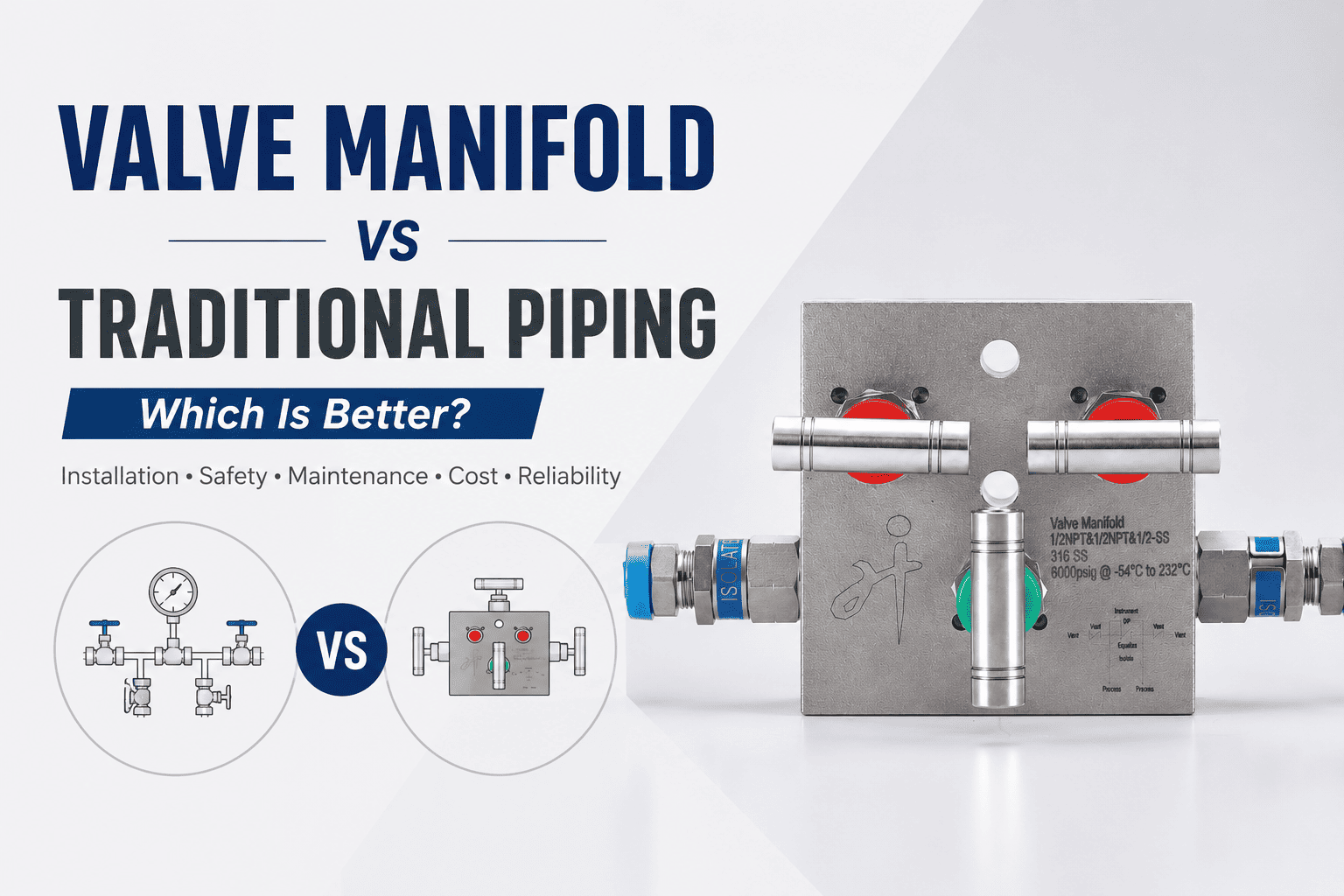
In industrial instrumentation systems, pressure transmitters, gauges, and other measuring devices require reliable isolation and control to ensure accurate readings and safe operation. Traditionally, these instruments have been connected using individual valves, fittings, and tubing assembled on site. However, with the increasing demand for safer, more compact, and efficient systems, integrated مشعب الصمام have become the preferred choice for many engineers and plant operators. If you are designing a new process line or upgrading an existing system, you may wonder whether a valve manifold or traditional piping is the better solution. While both methods can perform the same basic function, they differ significantly in terms of installation, maintenance, reliability, and long-term operating costs.
Understanding Traditional Instrument Piping
Traditional instrument piping consists of several individual components assembled together during installation. A typical system includes separate isolation valves, pipe nipples, elbows, tees, tube fittings, and instrument tubing. Depending on the application, additional drain or vent valves may also be required.
This approach has been used successfully for decades and still serves many industrial applications. It offers flexibility because each component can be selected independently, making it suitable for custom installations or systems with unique layout requirements.
However, because every component must be connected manually, the number of threaded or compression joints increases substantially. Each additional connection requires careful assembly and inspection, and every joint becomes a potential leak point throughout the service life of the system.
What Is a Valve Manifold?
A valve manifold integrates multiple valve functions into one compact assembly. Instead of connecting several individual valves together, the manifold combines isolation, equalizing, venting, and draining functions into a single factory-assembled unit.
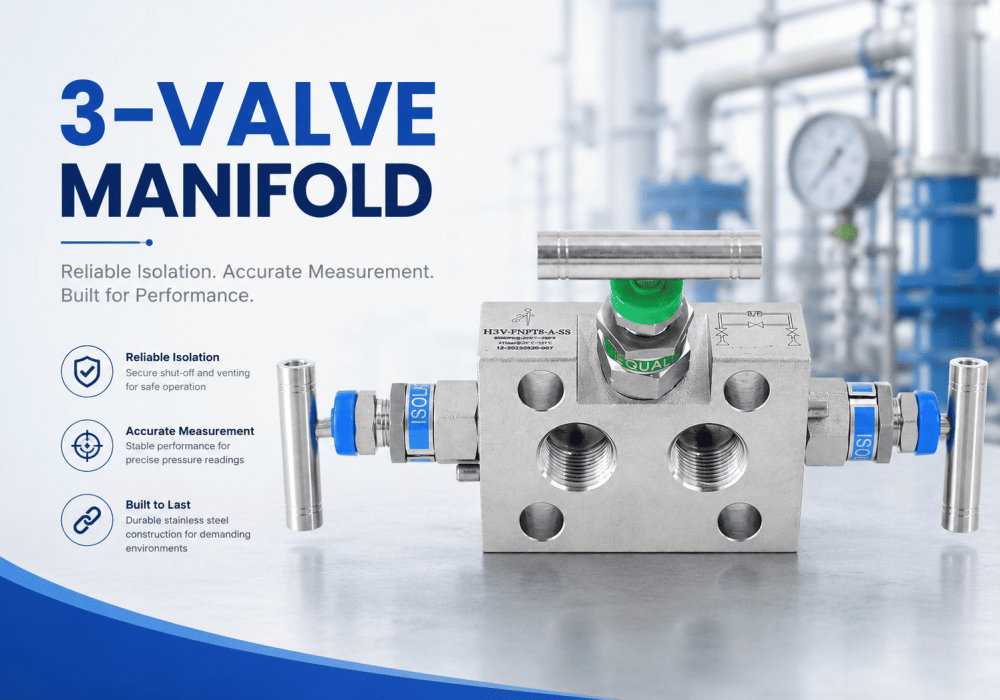
Depending on the application, valve manifolds are commonly available in 2-valve, 3-valve, and 5-valve configurations. They are specifically designed for pressure transmitters, differential pressure instruments, and pressure gauges.
Because the manifold is manufactured and tested before delivery, installation becomes much simpler and the overall system contains significantly fewer connections than a traditional piping arrangement.
Installation Efficiency
One of the most noticeable differences between the two solutions is installation time.
Traditional piping requires technicians to assemble every valve, fitting, adapter, and tube connection individually. This process can be labor-intensive, particularly in large projects where hundreds of instruments must be installed. Careful alignment, tightening, and leak testing are necessary at every connection, increasing both labor costs and installation time. Valve manifolds simplify this process considerably. Since multiple valve functions are integrated into one assembly, the installer only needs to connect the manifold to the process line and the instrument. The reduced number of components not only speeds up installation but also minimizes the possibility of assembly errors. For engineering contractors working under tight project schedules, this reduction in installation time can translate into significant savings in labor and commissioning costs.
Leak Prevention and System Safety
Leak prevention is a major concern in industries such as oil and gas, petrochemical processing, power generation, and chemical manufacturing. Even a minor leak can result in production losses, environmental hazards, or safety risks. Traditional piping systems contain numerous threaded joints and tube fitting connections. Although these connections are reliable when installed correctly, the likelihood of leakage naturally increases as the number of sealing points grows. Valve manifolds address this issue by reducing the total number of external connections. With fewer joints, there are fewer opportunities for leakage, resulting in a safer and more reliable system.
This advantage becomes especially important when handling hazardous gases, toxic chemicals, hydrogen, or other high-pressure media where leak prevention is critical.
Easier Maintenance and Calibration
Routine maintenance and instrument calibration are unavoidable in industrial facilities. During calibration, pressure transmitters often need to be isolated from the process while maintaining system safety.
With traditional piping, operators may need to close multiple valves in the correct sequence before calibration can begin. The procedure is generally more time-consuming and requires greater attention to avoid operational errors. Valve manifolds simplify these maintenance tasks by integrating all necessary valve functions into one unit. For example, a 5-valve manifold allows technicians to isolate the transmitter, equalize pressure, vent the system, perform calibration, and return the instrument to service using one compact assembly.
This streamlined design improves maintenance efficiency while reducing plant downtime.
Space Utilization
Modern industrial facilities are increasingly designed with compact layouts to maximize available space and simplify maintenance access.
Traditional piping often occupies more installation space because several individual valves and fittings must be arranged around the instrument. In crowded process areas, this larger footprint can create difficulties during installation and future maintenance. Stainless steel valve manifolds provide a much more compact solution. Their integrated design reduces the amount of tubing and the number of components required, making them ideal for offshore platforms, skid-mounted systems, modular process units, and instrument panels where space is limited.
A cleaner installation also improves the overall appearance of the instrumentation system and allows maintenance personnel easier access to surrounding equipment.
Reliability in Harsh Operating Conditions
Industrial environments often expose instrumentation to vibration, pressure fluctuations, and temperature changes. Over time, these operating conditions may loosen threaded connections or accelerate wear in systems with numerous individual components. Because valve manifolds contain fewer mechanical joints and are manufactured as rigid assemblies, they generally provide better resistance to vibration and mechanical stress. This enhanced structural stability contributes to improved long-term reliability and reduced maintenance requirements. For applications involving continuous operation or demanding environmental conditions, this increased reliability can have a significant impact on plant performance.
Long-Term Cost Considerations
At first glance, traditional piping may appear to be the more economical solution because individual components often have a lower initial purchase price than an integrated valve manifold.
However, purchase price represents only one part of the total cost of ownership.
Labor for installation, leak testing, maintenance, spare parts, periodic inspections, and potential downtime all contribute to the overall lifecycle cost of an instrumentation system.
Although valve manifolds generally require a higher initial investment, the savings achieved through faster installation, reduced maintenance, lower leakage risk, and improved reliability frequently outweigh the additional purchase cost over the life of the equipment.
For facilities focused on reducing operating expenses and improving long-term efficiency, valve manifolds often provide greater overall value.
Applications Best Suited for Valve Manifolds
Valve manifolds have become the preferred solution in many industries where process reliability and safety are priorities. They are widely used in oil and gas production, petrochemical plants, power generation, chemical processing, LNG facilities, hydrogen applications, water treatment systems, pharmaceutical manufacturing, and offshore installations.
These industries benefit from the manifold’s compact design, simplified maintenance, and improved leak prevention, all of which contribute to safer and more efficient plant operation.
When Traditional Piping Remains a Practical Choice
Despite the many advantages of valve manifolds, traditional piping continues to have its place.
Applications requiring highly customized layouts, temporary testing systems, laboratory equipment, or low-pressure utility services may still benefit from the flexibility offered by individual components. In these situations, engineers can configure the piping arrangement to meet unique installation requirements without being limited by a standard manifold design.
Choosing the right solution ultimately depends on the specific operating conditions, available installation space, maintenance requirements, and project budget.
Both valve manifolds and traditional piping are capable of supporting industrial instrumentation systems, but they serve different needs.
Traditional piping offers excellent flexibility and remains suitable for specialized or temporary applications where custom configurations are required. However, for most permanent industrial installations, valve manifolds provide clear advantages. Their integrated design simplifies installation, reduces the number of leak points, minimizes maintenance time, saves valuable space, and improves overall system reliability.
As industrial facilities continue to prioritize safety, operational efficiency, and lower lifecycle costs, valve manifolds have become the preferred choice for modern instrumentation systems. Selecting the appropriate 2-valve, 3-valve, or 5-valve manifold can help improve process reliability while reducing maintenance and operating expenses for years to come.
 Arabic
  English
  Spanish
  Russian