
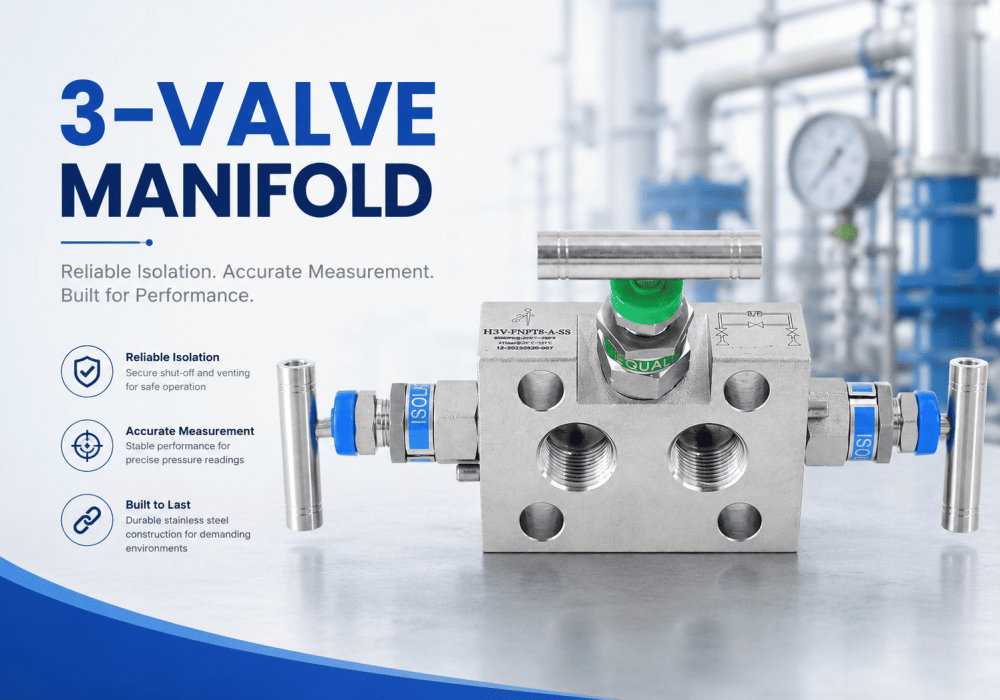
In industrial instrumentation systems, accurate pressure measurement is essential for safe and efficient operation. Differential pressure transmitters are widely used to measure flow, level, and pressure in industries such as oil and gas, chemical processing, power generation, and water treatment. To ensure reliable operation and simplify maintenance, a 3-valve manifold is commonly installed between the process line and the differential pressure transmitter. This compact assembly allows operators to isolate, equalize, and calibrate pressure instruments without interrupting the process.
In this guide, we will explain what a 3-valve manifold is, how it works, its advantages, applications, and how to choose the right manifold for your instrumentation system.
What Is a 3-Valve Manifold?
A 3-valve manifold is an instrumentation valve assembly designed specifically for differential pressure transmitters. It consists of three integrated valves:
- Two block valves
- One equalizing valve
The manifold serves as the connection point between the process pipeline and the pressure transmitter, enabling safe isolation and pressure equalization during calibration, maintenance, or transmitter replacement.
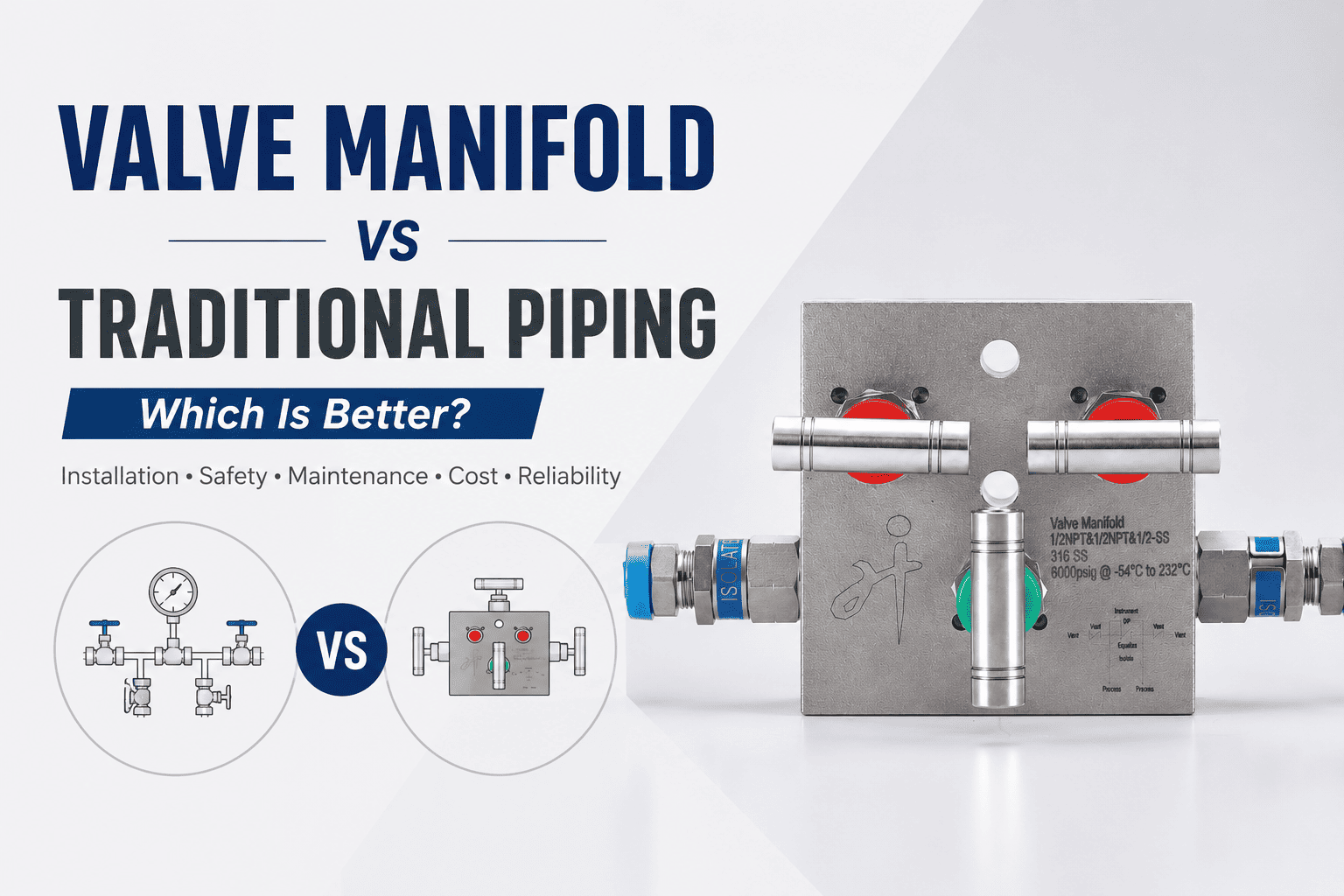
Compared with traditional piping arrangements using multiple individual valves and fittings, a 3-valve manifold offers a more compact, reliable, and cost-effective solution.
Main Components of a 3-Valve Manifold
High-Pressure Block Valve
The high-pressure block valve controls the pressure entering the high-pressure side of the differential pressure transmitter.
Its primary functions include:
- Isolating the high-pressure process line
- Protecting the transmitter during maintenance
- Allowing controlled commissioning procedures
Low-Pressure Block Valve
The low-pressure block valve performs the same function on the low-pressure side of the transmitter.
It enables operators to:
- Shut off the low-pressure process connection
- Perform maintenance safely
- Isolate the instrument when required
Equalizing Valve
The equalizing valve connects the high-pressure and low-pressure sides internally.
When opened, it balances pressure across both sides of the transmitter, preventing damage caused by excessive differential pressure during startup or calibration.
How Does a 3-Valve Manifold Work?
Understanding the operating sequence is crucial for maintaining measurement accuracy and protecting instrumentation equipment.
Normal Operating Condition
During normal process operation:
- High-pressure block valve: Open
- Low-pressure block valve: Open
- Equalizing valve: Closed
In this configuration, process pressure reaches both sides of the differential pressure transmitter, allowing accurate measurement.
Calibration Procedure
Before calibration:
- Open the equalizing valve.
- Equalize pressure on both sides of the transmitter.
- Close both block valves.
- Perform calibration safely.
This sequence prevents sudden pressure shocks that could damage sensitive sensing elements.
Maintenance Procedure
When transmitter maintenance is required:
- Open the equalizing valve.
- Close both block valves.
- Vent or disconnect the transmitter.
- Carry out maintenance work.
The manifold allows maintenance without shutting down the entire process system.
Advantages of Using a 3-Valve Manifold
Improved Safety
By isolating process pressure and equalizing pressure before maintenance, operators can work safely on instrumentation equipment.
Reduced Leakage Points
Integrated manifold construction significantly reduces the number of tubing connections and threaded joints, minimizing potential leak paths.
Easier Calibration
The equalizing valve simplifies transmitter calibration and zero adjustment procedures.
Compact Installation
A single manifold replaces multiple individual valves and fittings, reducing installation space requirements.
Lower Maintenance Costs
Fewer components mean reduced maintenance effort and improved long-term reliability.
Enhanced Instrument Protection
Proper pressure equalization helps prevent over-ranging and mechanical stress on differential pressure transmitters.
Common Applications of 3-Valve Manifolds
Differential Pressure Flow Measurement
3-valve manifolds are widely used with:
- Orifice plates
- Venturi tubes
- Flow nozzles
They provide safe isolation of flow measurement instruments while maintaining system integrity.
Tank Level Measurement
In closed tanks and vessels, differential pressure transmitters are often used to determine liquid level. A 3-valve manifold simplifies calibration and maintenance procedures.
Filter Monitoring
Pressure drop across filters can indicate contamination or blockage. A 3-valve manifold allows accurate monitoring while protecting instrumentation equipment.
Process Pressure Control Systems
Industrial control loops frequently rely on differential pressure measurements. Manifolds improve measurement reliability and operational safety.
How to Choose the Right 3-Valve Manifold
Material Selection
For most industrial environments, SS316 or SS316L stainless steel provides excellent corrosion resistance and durability.
تصنيف الضغط
Choose a manifold with a pressure rating that exceeds the maximum system operating pressure.
Common ratings include:
- 3000 psi
- 6000 psi
- 10000 psi
توصيلات النهاية
Available connection types include:
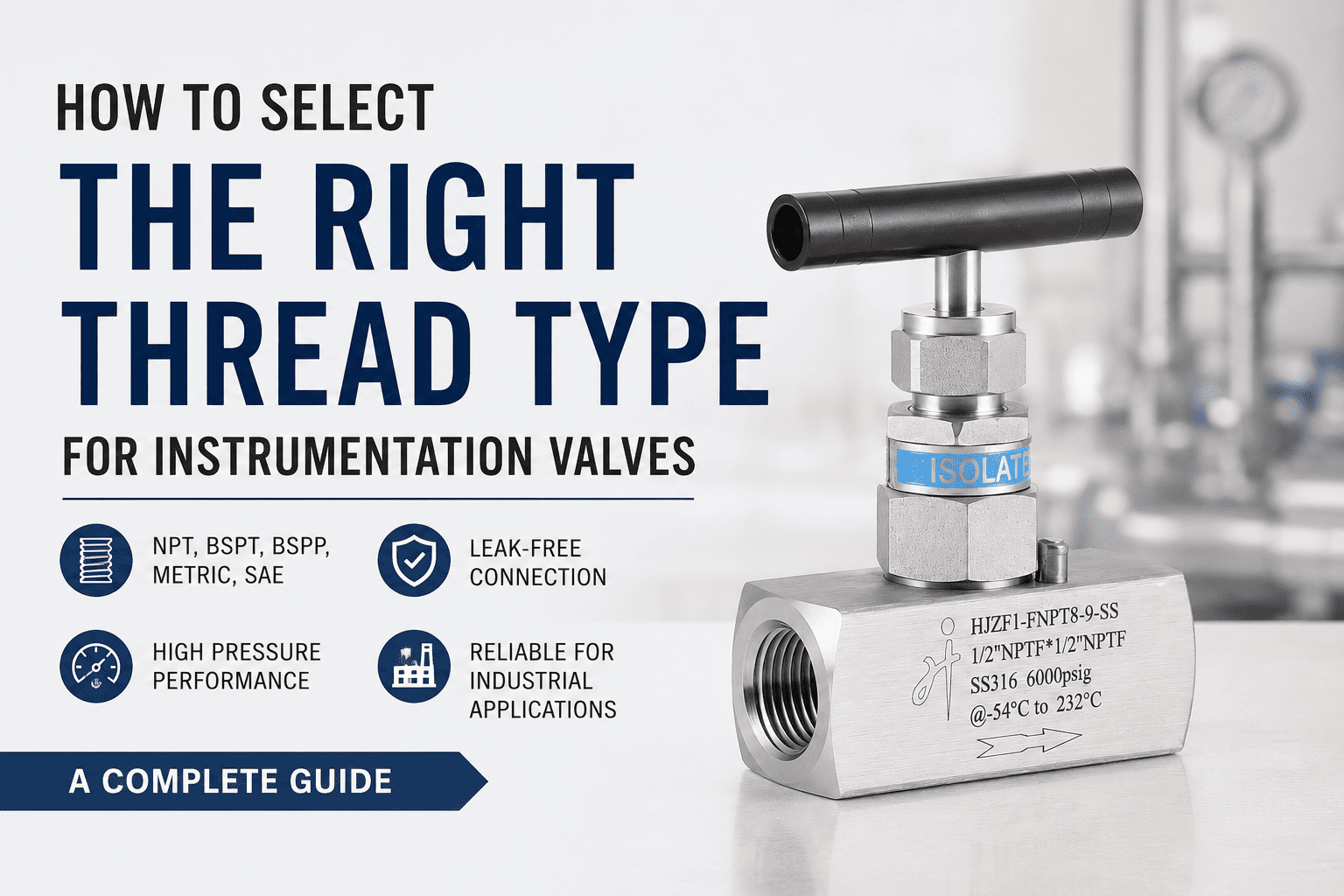
- 1/2″ NPT Female
- 1/2″ NPT Male
- Flanged connections
Custom process connections
Mounting Configuration
Select a manifold compatible with your transmitter mounting style:
- Direct mount
- Coplanar mount
- Remote mount
Industry Requirements
Consider temperature, media compatibility, corrosion resistance, and industry standards before making a selection.
Why Choose HONGJI Stainless Steel 3-Valve Manifolds?
HONGJI manufactures high-quality stainless steel instrumentation valves متشعبات designed for demanding industrial applications.
Key benefits include:
- Precision-machined SS316/SS316L construction
- Excellent sealing performance
- High-pressure capability
- Compact and robust design
- Strict quality inspection procedures
- Suitable for oil & gas, chemical, power, and instrumentation systems
Our 3-valve manifolds are engineered to provide reliable isolation, accurate pressure equalization, and long service life even in harsh operating environments.
A 3 way valve manifold is an essential component in differential pressure measurement systems. By combining two block valves and one equalizing valve into a compact assembly, it improves safety, simplifies maintenance, and enhances measurement reliability.
Whether used in flow measurement, level monitoring, filter applications, or process control systems, a high-quality stainless steel 3-valve manifold helps ensure accurate and dependable instrument performance.
When selecting a manifold, consider factors such as pressure rating, material compatibility, connection type, and application requirements to achieve the best results for your instrumentation system.


 Arabic
  English
  Spanish
  Russian